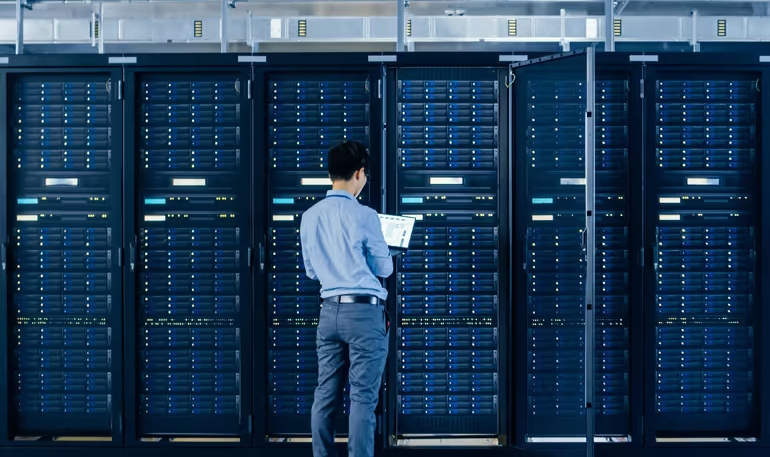
Data center downtime costs Indian enterprises an average of ₹8.4 lakhs per hour, with 60% of outages caused by power failures and 25% by thermal issues. In India’s demanding climate where summer temperatures exceed 45°C and voltage fluctuations are common professional data center solutions aren’t optional; they’re survival infrastructure. Modern data centers must deliver 99.995% uptime (Tier III) while optimizing for Power Usage Effectiveness (PUE) below 1.5 to control escalating energy costs.
Core Components: Building Blocks of Resilient Data Centers
1. Server Racks & Physical Infrastructure: The Foundation
Enterprise-Grade Racks (42U Standard):
- Load capacity: 1,500-3,000 kg dynamic load rating
- Depth: 800-1,200mm for deep servers (GPU clusters)
- Width: 600mm standard, 800mm for cable management
- Features: Tool-less mounting, cable management arms, thermal chimneys
Leading Brands in India:
- Schneider Electric NetShelter: Most deployed in Indian enterprises, NABL-certified
- Vertiv VR Rack: Excellent for high-density cooling (up to 30 kW/rack)
- HPE 10642 G2: Integrated with HPE OneView for automated asset tracking
Rack Accessories for Indian Conditions:
- Blanking panels: Prevent hot air recirculation (critical for dust-heavy environments)
- Brush strips: Maintain airflow while allowing cable entry
- Vertical PDUs: 0U mounting saves rack space
- Environmental sensors: Per-cabinet temperature/humidity monitoring
2. Precision Cooling Systems: Beating the Indian Heat
India’s climate demands robust cooling strategies. Standard office AC (designed for human comfort at 24-26°C) cannot handle server heat loads (35-40 kW per rack in high-density deployments).
Cooling Technologies:
Precision Air Conditioning (CRAC/CRAH):
- CRAC (Computer Room Air Conditioner): DX-based, self-contained units
- CRAH (Computer Room Air Handler): Chilled water-based, more efficient
- Capacity: 10-150 kW per unit
- Target supply air: 18-20°C at rack inlet
Hot Aisle/Cold Aisle Containment:
- Cold aisle containment (CAC): Encloses cold aisle, prevents mixing
- Hot aisle containment (HAC): Encloses hot aisle, more efficient
- ROI: 15-25% energy savings, 3-5°C lower server inlet temps
In-Row Cooling (for high-density):
- Liebert CRV (Vertiv): Up to 40 kW cooling directly at rack row
- Schneider InRow: Variable-speed fans, matches server load dynamically
- Use case: GPU clusters, AI/ML workloads exceeding 15 kW/rack
Refrigerants & Environmental Compliance:
- R410A being phased out (high GWP)
- R32 or R513A: Lower global warming potential, MEPS-compliant
Indian-Specific Cooling Challenges:
- Monsoon humidity: Dehumidification required (target: 40-55% RH)
- Dust storms: Pre-filters on CRAC units, increased maintenance cycles
- Power shortages: Thermal energy storage (TES) tanks provide 30-60 minute backup cooling
3. Intelligent Power Distribution: Surviving India’s Grid Instability
Indian power grids deliver 230V ±10% nominally, but actual fluctuations of ±20-30% are common in Tier 2/3 cities. Voltage spikes, sags, and sustained under-voltage are leading causes of premature hardware failure.
Power Infrastructure Stack:
A. UPS Systems (Uninterruptible Power Supply):
Online/Double-Conversion UPS (Mandatory for Data Centers):
- How it works: AC → DC → AC, complete isolation from grid
- Protection: Zero transfer time, handles all voltage anomalies
- Capacity: 10-1000 kVA modular units
India’s Top UPS Brands:
- Schneider Electric APC Symmetra: Modular, hot-swappable batteries, 96% efficiency
- Vertiv Liebert EXS: Lithium-ion battery option (2x lifespan vs. VRLA)
- Delta Amplon: Cost-effective for SMB data centers, excellent service network
- Emerson/Vertiv: Dominant in Indian BFSI sector
Battery Technologies:
- VRLA (Valve-Regulated Lead Acid): 3-5 year lifespan, ₹8,000-12,000/kWh
- Lithium-ion: 8-10 year lifespan, 50% smaller footprint, ₹15,000-22,000/kWh
- ROI: Lithium pays for itself in 5-7 years through reduced replacement costs
B. Voltage Stabilizers & Conditioners:
- Servo stabilizers: ±1% output accuracy for critical loads
- Isolation transformers: Block electrical noise and surges
- TVSS (Transient Voltage Surge Suppressors): Protect against lightning strikes
C. Diesel Generators (DG Sets):
- Sizing: 1.25x of total load for headroom
- Fuel autonomy: 24-72 hours (consider fuel delivery challenges in remote areas)
- ATS (Automatic Transfer Switch): <10 second switchover
- Leading brands: Cummins India, Kirloskar, Mahindra Powerol
D. Power Distribution Units (PDUs):
- Metered PDUs: Monitor current, kWh consumption per rack
- Switched PDUs: Remote outlet control for power cycling servers
- Three-phase PDUs: Balance load across phases (critical for harmonic mitigation)
4. Environmental Monitoring: The Watchful Eye
24/7 Monitoring is Non-Negotiable: A cooling failure can cause thermal shutdown in 5-10 minutes in high-density racks.
Sensor Network:
Temperature & Humidity:
- Placement: Top, middle, bottom of each rack; CRAC supply/return; underfloor
- Alerts: >25°C at server inlet, <40% or >60% RH
- Bennett: bmsenterprises.co.in, RLE Technologies (US import)
Water Leak Detection:
- Sensing cables: Run under raised floor, around CRAC units
- Critical in India: Monsoon flooding, plumbing failures in multi-tenant buildings
- Response: Auto-shutoff solenoid valves on chilled water lines
Smoke Detection:
- VESDA (Very Early Smoke Detection Apparatus): Detects smoke at 0.005% obscuration (vs. 3-5% for standard detectors)
- Cost: ₹2-3 Lakhs per zone, detects fire 30-60 minutes earlier
Power Quality Monitoring:
- Harmonic distortion: Measure THD (Total Harmonic Distortion), should be <5%
- Power factor: Target >0.95, avoid penalties from DISCOMs
- Voltage sags/swells: Log events to identify patterns and equipment issues
5. Fire Detection & Suppression: Protecting Critical Assets
Indian Fire Safety Codes for Data Centers:
- NBC 2016 (National Building Code): Part 4 defines data center fire safety
- IS 2189: Code of practice for selection, installation, and maintenance of automatic fire detection system
- Local fire department approvals: Mandatory for commercial operations
Fire Suppression Systems:
Pre-Action Sprinkler System:
- Dry pipe: Water held back by valve, only releases on dual detection (smoke + heat)
- Safe for data centers: Accidental discharge highly unlikely
- Cost-effective: ₹1-1.5 Lakhs per 1000 sq ft
Clean Agent Systems (for server rooms):
- FM-200 (HFC-227ea): 7% concentration, safe for occupied spaces, ₹15-20 Lakhs for 500 sq ft
- Novec 1230: Environmentally friendly, zero ozone depletion, ₹20-25 Lakhs for 500 sq ft
- Inergen (IG-541): Inert gas mixture, requires sealed room, ₹12-18 Lakhs for 500 sq ft
Detection Systems:
- VESDA: Detects smoldering electronics early
- Spot smoke detectors: Photo-electric type, avoid ionization (false alarms)
- Linear heat detection: Along cable trays and under raised floor
Indian Best Practices:
- IRDAI mandate: Insurance providers require FM-200/Novec for data center coverage
- Fire audit: Annual inspection by certified agency (e.g., Fire and Safety Audit Services India)
- Mock drills: Quarterly evacuation and fire suppression tests
High Availability Design: Uptime Institute Tier Standards
Understanding Tiers for Indian Enterprises
| Tier | Uptime | Downtime/Year | Redundancy | Indian Use Case |
|---|---|---|---|---|
| Tier I | 99.671% | 28.8 hours | N (no redundancy) | Small office server room |
| Tier II | 99.741% | 22.0 hours | N+1 (partial) | Remote branch data centers |
| Tier III | 99.982% | 1.6 hours | N+1 (concurrently maintainable) | Recommended for most Indian enterprises |
| Tier IV | 99.995% | 26.3 minutes | 2N (fault tolerant) | Large banks, telcos, hyperscalers |
Tier III Certification Process (via Uptime Institute):
- Design Documents review (₹15-20 Lakhs fee)
- Construction review (₹10-15 Lakhs)
- Post-construction commissioning (₹20-30 Lakhs)
- Total timeline: 12-18 months, total cost: ₹45-65 Lakhs
Indian Alternative: STQC Certification (Standardization Testing and Quality Certification) under MeitY is recognized for government data centers, costing ₹8-12 Lakhs.
India-Specific Power Challenges & Advanced Solutions
Challenge 1: Voltage Fluctuations & Harmonics
Problem: Indian grids suffer from voltage sags (20% drop for 100ms) and harmonic distortion (THD 8-12% vs. IEEE 519 limit of 5%). This causes:
- Premature PSU failure in servers
- Data corruption on storage arrays
- Inefficient cooling (VFD harmonics)
Solution:
- Active Voltage Conditioners (AVC): Maintain ±2% output, ₹3-5 Lakhs per 100 kVA
- Harmonic filters: Active filters at UPS input, ₹1-2 Lakhs per 100A
- Isolation transformers: K-rated (K-13, K-20) for harmonic-rich loads, ₹1.5-2 Lakhs per 50 kVA
Challenge 2: Load Shedding & Scheduled Outages
Problem: Many Indian cities face 2-6 hours of power cuts during peak summer. DG fuel logistics become critical.
Solution:
- Fuel cell backup: Methanol-based fuel cells provide 8-72 hours runtime, refuel in 5 minutes (vs. hours for diesel delivery)
- Battery energy storage: Lithium-ion BES system can provide 30-60 minutes, smooths DG startup
- Dual DG configuration: N+1 redundancy ensures maintenance doesn’t impact availability
Challenge 3: Power Factor Penalties
Problem: DISCOMs penalize if power factor (PF) <0.9, adding 5-10% to electricity bills.
Solution:
- Automatic PF correction panels: Capacitor banks with APFC relay, ₹50,000-1.5 Lakhs
- Savings: Payback in 6-12 months through avoided penalties
Renewable Energy Integration
Solar Power for Data Centers:
- Rooftop solar: 50-200 kW systems reduce grid dependency
- Challenge: Intermittent generation, requires battery storage
- Solution: Solar + Lithium battery + Grid + DG hybrid system
- ROI: 15-18% IRR, payback in 6-8 years with accelerated depreciation
Green Energy Certificates (RECs):
- Purchase green power from open access in states like Gujarat, Karnataka
- Cost premium: ₹0.50-1.00 per kWh
- Benefit: Meets ESG goals, attracts environmentally conscious clients
Data Center Infrastructure Management (DCIM): The Brain
What is DCIM Software?
DCIM bridges IT and facilities management, providing real-time visibility into power, cooling, space, and capacity.
Leading DCIM Platforms in India:
- Schneider Electric EcoStruxure IT: Cloud-based, AI-driven insights, strong Indian support
- Vertiv Trellis: Comprehensive asset and capacity management
- Nlyte Software: Enterprise-grade, used by SBI, HDFC
- Open-source: RackTables, NetBox (cost-effective for SMBs)
Core DCIM Capabilities:
Power Management:
- Track kWh consumption per rack, customer, application
- PUE calculation: Real-time and trending (target: <1.5)
- Capacity planning: Predict when UPS/cooling will max out
- Load balancing: Ensure even distribution across phases
Cooling Management:
- Temperature heat maps: Visualize hotspots before they cause failures
- CFM/airflow tracking: Ensure cooling matches server load
- Cooling optimization: Adjust CRAC setpoints based on load, save 15-20% energy
Space & Asset Management:
- 3D visual modeling: Drag-and-drop rack layouts
- Asset tracking: RFID/barcode integration for automated inventory
- Connectivity management: Document inter-rack cabling, reduce troubleshooting time by 60%
Integration with ITSM:
- ServiceNow CMDB: Auto-populate configuration items
- Incident correlation: Cooling failure → auto-create ticket, alert on-call engineer
- Change management: Reserve rack space, power, network ports via service catalog
Industry-Specific Data Center Solutions
BFSI (Banking, Financial Services, Insurance)
Regulatory Requirements:
- RBI Cyber Security Framework: DR site within 500 km, RTO <4 hours
- Uptime: Minimum Tier III with 2N redundancy
- Encryption: At-rest and in-transit data protection
Solution Architecture:
- Active-Active data centers: Mumbai-Pune, Delhi-Noida, Bangalore-Chennai pairs
- Dark fiber: Low-latency synchronous replication (<5ms RTT)
- Power: 2N UPS + DG with 72-hour fuel autonomy
- Cost: ₹8-15 Crores for 500 rack facility
Indian Example: HDFC Bank operates Tier III+ data centers in Pune and Bengaluru with <15 minute failover time.
Healthcare (Hospitals, Diagnostic Chains)
Requirements:
- HL7 integration: Medical equipment connectivity
- Uptime: Tier II+ for patient records, Tier III for critical systems
- Power quality: Medical-grade isolation for imaging equipment (MRI, CT)
Solution:
- Edge micro data centers: 5-10 rack closets per hospital building
- Modular UPS: Scalable power as equipment added
- Isolated ground: Separate electrical ground for sensitive equipment
- Cost: ₹50-80 Lakhs for 100-bed hospital data center
IT/ITES (Software, BPO Companies)
Requirements:
- Scalability: Rapid expansion for new clients
- Security: SOC 2, ISO 27001 compliance
- Cost-efficiency: Minimize OPEX in competitive market
Solution:
- Colocation: Use providers like Sify, NxtGen, Pi Data Centers (avoid Capex)
- Modular data centers: Schneider EcoDataCenter or Vertiv SmartMod – deploy in 12 weeks vs. 12 months
- Power: Target PUE <1.4 through efficient design
- Cost: ₹15,000-25,000 per rack/month colocation vs. ₹8-12 Lakhs to build own
Manufacturing (Automotive, Pharma, Heavy Industry)
Requirements:
- Edge computing: Real-time processing for IoT sensors
- Harsh environments: Dust, vibration, temperature extremes
- Integration: OT (Operational Technology) + IT convergence
Solution:
- Ruggedized racks: NEMA/IP-rated enclosures with filtration
- Air conditioning: Industrial-grade units with corrosion-resistant coils
- Power: Double-conversion UPS with extended temperature range (-10°C to 50°C)
- Cost: ₹30-50 Lakhs for edge data center with 10-15 racks
Implementation Roadmap: From Concept to Operations
Phase 1: Assessment & Planning (2-4 Weeks)
- [ ] Load assessment: Calculate current and 5-year power/cooling requirements
- [ ] Site survey: Evaluate existing facility or greenfield location
- [ ] Tier goal definition: Align business needs with Tier I-IV standards
- [ ] Budgeting: Total project cost estimation (construction + equipment)
- [ ] Regulatory approval: Fire department, electrical inspector, environmental clearance
Phase 2: Design & Engineering (4-6 Weeks)
- [ ] Mechanical drawings: CRAC layout, containment design, airflow CFD modeling
- [ ] Electrical single-line diagram: UPS, DG, switchgear, PDU architecture
- [ ] BMS integration points: Specify protocols (Modbus, BACnet) for DCIM
- [ ] Vendor selection: Issue RFPs for critical equipment (UPS, CRAC, racks)
- [ ] Peer review: Third-party validation by certified data center designer
Phase 3: Procurement & Construction (8-16 Weeks)
- [ ] Raised floor installation: 600mm height for cable management and airflow
- [ ] Electrical works: Panel installation, cable routing, earth pit construction
- [ ] Mechanical works: CRAC/CRAH installation, chilled water piping
- [ ] Fire suppression: Piping, VESDA installation, agent tanks
- [ ] Security: Biometric access, CCTV, mantraps
Phase 4: Commissioning & Testing (2-4 Weeks)
- [ ] Integrated System Testing (IST): Simulate failures, verify failover
- [ ] Load bank testing: Run UPS and DG at full load for 4+ hours
- [ ] CFD validation: Measure actual vs. modeled airflow/temperature
- [ ] BMS/DCIM integration: Verify all sensors feeding correctly
- [ ] Documentation: As-built drawings, O&M manuals, SOPs
Phase 5: Operations & Maintenance (Ongoing)
- [ ] Preventive maintenance: Monthly CRAC filter changes, quarterly battery tests
- [ ] Thermography: Annual IR scanning of electrical connections
- [ ] Capacity reviews: Quarterly power/cooling capacity vs. growth projections
- [ ] Incident response drills: Simulate power failure, cooling loss, fire
- [ ] Training: DC staff certification (Uptime Institute ATD/ATS)
ROI & Cost Analysis (Indian Mid-Market Enterprise, 50-Rack Data Center)
Capital Expenditure (Initial Investment)
| Component | Cost (₹) | Notes |
|---|---|---|
| Racks (50×42U) | 12 Lakhs | Schneider NetShelter SX, including PDUs |
| UPS (2×100 kVA, 2N) | 35 Lakhs | APC Symmetra MW, lithium-ion batteries |
| DG Set (250 kVA) | 18 Lakhs | Cummins India with AMF panel |
| Precision Cooling (3×40 kW) | 45 Lakhs | Vertiv Liebert CRV, N+1 |
| Fire Suppression | 15 Lakhs | FM-200 system, VESDA |
| Electrical & Switchgear | 25 Lakhs | Panels, cables, ATS, stabilizers |
| Raised Floor & Civil | 20 Lakhs | 600mm anti-static floor, sealing |
| DCIM Software | 8 Lakhs | Schneider EcoStruxure IT, 3-year license |
| Installation & Commissioning | 12 Lakhs | 10% of equipment cost |
| Contingency (10%) | 19 Lakhs | |
| TOTAL CAPEX | ₹2.09 Crores |
Operational Expenditure (Annual)
| Item | Cost (₹) | Notes |
|---|---|---|
| Electricity | 28 Lakhs | 180 kW average load @ ₹9/unit, 8760 hours |
| DG Fuel | 6 Lakhs | 500 hours/year @ ₹90/liter |
| Maintenance Contracts | 15 Lakhs | UPS, CRAC, DG annual maintenance |
| Manpower | 24 Lakhs | 2 engineers + 1 facility manager |
| Spares | 5 Lakhs | Batteries, filters, sensors |
| Insurance | 3 Lakhs | Fire, equipment breakdown |
| TOTAL OPEX | ₹81 Lakhs/year |
Cost of Downtime (Without Proper Data Center)
| Scenario | Probability | Cost per Incident | Annual Risk |
|---|---|---|---|
| Power outage (2 hours) | 4x/year | ₹16.8 Lakhs | ₹67.2 Lakhs |
| Cooling failure (4 hours) | 1x/year | ₹33.6 Lakhs | ₹33.6 Lakhs |
| Fire (total loss) | 0.1x/year | ₹5 Crores | ₹50 Lakhs |
| TOTAL ANNUAL RISK | ₹1.51 Crores |
ROI Calculation
Net Annual Benefit: ₹1.51 Crores (avoided risk) – ₹81 Lakhs (OPEX) = ₹70 Lakhs
Payback Period: ₹2.09 Crores CAPEX ÷ ₹70 Lakhs annual benefit = 2.98 years
10-Year NPV: @12% discount rate, ₹2.38 Crores positive NPV
Key Insight: For Indian enterprises, investing in a Tier III data center pays for itself in <3 years through avoided downtime costs alone.
Future Trends: Next-Generation Data Centers
Modular Data Centers (Prefabricated)
Prefabricated Power/Cooling Modules: Factory-built, shipped to site, plug-and-play.
- Deployment: 50% faster, 20% cheaper than traditional build
- Brands: Schneider Electric EcoDataCenter, Vertiv SmartMod, HPE Performance-Optimized Data Center (POD)
- Indian adoption: Paytm deployed modular data centers for payment processing
Liquid Cooling for High-Density
Direct-to-Chip Cooling: Cold plates on CPUs/GPUs, coolant circulated to CDU (Coolant Distribution Unit).
- Density: Support 50+ kW per rack (AI/ML workloads)
- PUE: Achieve 1.05-1.15
- Vendors: Asetek, CoolIT Systems (Dell EMC partnership)
Immersion Cooling: Servers submerged in dielectric fluid.
- Two-phase immersion: 3M Novec fluid boils at 34°C, passive cooling
- Single-phase immersion: GRC (Green Revolution Cooling) active pumping
- Indian pilot: CtrlS (Hyderabad) testing immersion for crypto mining
Edge Data Centers
Micro Data Centers (MDC): 2-10 rack deployments at factory, hospital, retail locations.
- Drivers: 5G, IoT latency requirements
- Power: Hybrid solar + battery + grid
- Cooling: Self-contained, no external water required
- Management: Remotely monitored via DCIM
Renewable Energy Integration
Solar + Battery Microgrid:
- Solar capacity: 100-500 kW rooftop arrays
- Battery storage: 200-1000 kWh lithium-ion
- Use case: Peak shaving, grid outage ride-through
- Indian subsidies: 40% subsidy for rooftop solar via MNRE
Green Data Center Certifications:
- IGBC Green Data Center Rating: Indian Green Building Council
- Benefits: Property tax rebates (some states), marketing advantage
- Cost premium: 8-12% upfront, 15-20% energy savings ongoing
AI-Driven DCIM
Machine Learning Applications:
- Predictive failure: Forecast battery, fan, capacitor failures 30 days ahead
- Cooling optimization: AI adjusts CRAC setpoints based on weather forecast, saves 8-12% energy
- Capacity planning: Auto-predict when power/cooling exhausted based on growth trends
Common Pitfalls & How to Avoid Them
Pitfall 1: Undersized UPS & Cooling
- Mistake: Sizing for today’s load only, no headroom
- Consequence: Costly retrofit in 2-3 years, downtime during upgrade
- Solution: Plan for 5-year growth, include 25-30% buffer capacity
Pitfall 2: Poor Cable Management Blocking Airflow
- Mistake: Cables draped over servers, blocking exhaust
- Consequence: Hotspots, server thermal throttling, 20% cooling inefficiency
- Solution: Structured cabling, cable management arms, blanking panels mandatory
Pitfall 3: Neglecting Preventive Maintenance
- Mistake: Skipping monthly filter changes, battery tests
- Consequence: Unexpected failures, voided warranty, audit failures
- Solution: Annual maintenance contract (AMC) with OEM, SLA with penalties
Pitfall 4: Not Planning for Density Increases
- Mistake: Design for 5 kW/rack, future GPUs require 20 kW/rack
- Consequence: Cannot support AI/ML workloads, stranded capacity
- Solution: In-row cooling readiness, higher amp PDUs (even if not used initially)
Pitfall 5: Ignoring Harmonic Distortion
- Mistake: No harmonic analysis, running mixed linear/non-linear loads
- Consequence: Transformer overheating, generator failure during outage
- Solution: K-rated transformers, active harmonic filters, load segregation
Compliance & Certifications: Indian Landscape
Uptime Institute Tier Certification
- Process: Design, Construction, Operational Sustainability reviews
- Cost: ₹45-65 Lakhs total
- Value: Essential for BFSI, cloud providers, enterprises with global clients
ISO Standards
ISO 50001 (Energy Management System):
- Benefits: 10-15% energy reduction, improves PUE
- Cost: ₹3-5 Lakhs for certification
- Timeline: 6-12 months implementation
ISO 27001 (Information Security):
- Includes: Physical security controls (Clause A.11)
- Data center-specific: Access control, surveillance, environmental protection
- Cost: ₹5-8 Lakhs, audit every 3 years
MeitY Guidelines for Government Data Centers
- Mandatory: Tier III minimum, DPDP Act compliance, STQC certification
- Procurement: Must go through GeM (Government e-Marketplace) portal
- Security: NIC security audit before go-live
RBI Guidelines for Banks
- Data center classification: Critical, important, normal based on business impact
- DR drills: Quarterly switchover testing
- Audit: Annual IS audit by empanelled auditors
Conclusion: Invest in Resilience, Not Just Infrastructure
In India’s challenging operating environment unpredictable power, extreme heat, regulatory complexity a professional data center is not a cost center but a strategic risk mitigator. The math is clear: ₹2 Crores invested saves ₹1.5 Crores annually in avoided downtime, protects ₹50+ Crores of business value, and enables digital transformation with confidence.
Key Takeaways:
- Tier III design is the minimum for business-critical operations in India
- Lithium-ion UPS pays for itself in 5 years despite higher upfront cost
- DCIM software reduces OPEX by 15-20% through optimization
- Modular approach cuts deployment time by 50% and reduces risk
- Renewable integration future-proofs against rising energy costs
Next Step: Start with a Data Center Readiness Assessment a 2-week engagement that benchmarks your current facility against Tier standards, identifies single points of failure, and provides a 3-year modernization roadmap.
Writer’s Note:
This analysis was prepared by Jaideep Singh, specializing in critical infrastructure design for Indian enterprises. With extensive experience in Tier III data center commissioning for BFSI and IT/ITES sectors, the cost models and ROI calculations reflect real-world Indian implementations. For STQC certification guidance or DPDP Act compliance for data centers, please reach out directly.

